

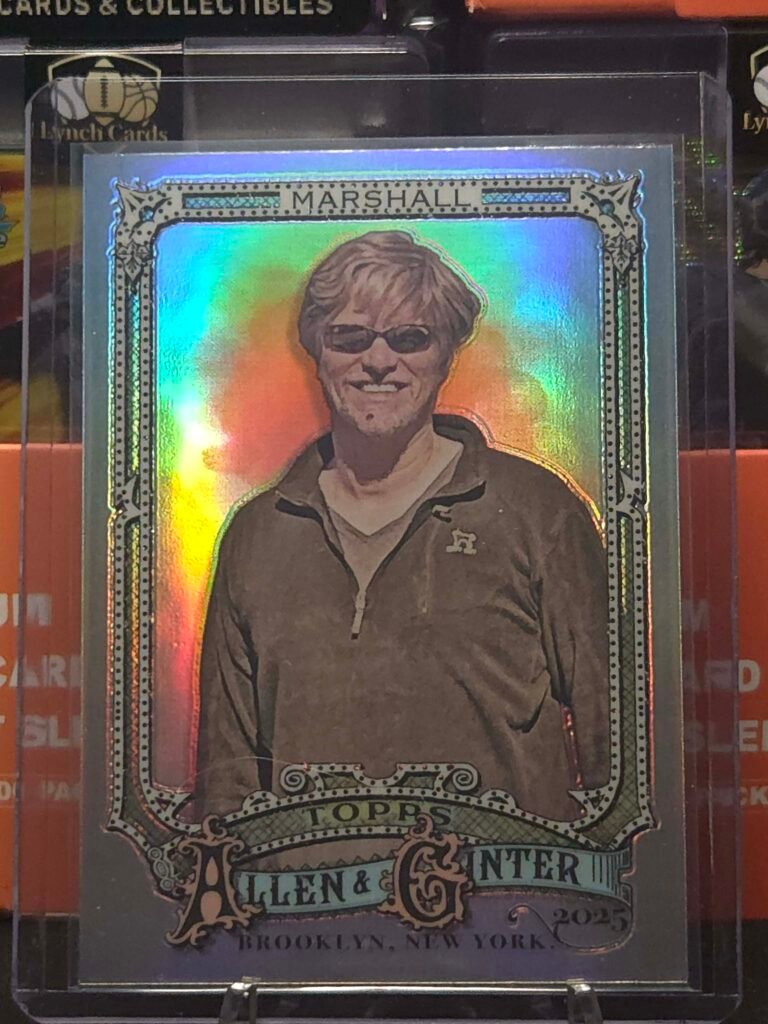
The Topps Allen & Ginter set has always existed at the intersection of sport, culture, and history. While baseball provides the foundation, the product’s identity is built on its willingness to honor influence wherever it appears. The inclusion of Tom Marshall reflects that philosophy, preserving the legacy of a creative force whose work helped shape one of the most devoted fanbases in modern music.
For collectors, Marshall’s Allen & Ginter card represents a story-driven collectible—one rooted in cultural impact rather than statistical achievement.
The Lyricist Who Helped Define Phish

Tom Marshall’s connection to Phish predates the band itself. A childhood friend of Trey Anastasio, Marshall became the primary lyricist behind much of Phish’s catalog, providing a voice that balanced abstraction, emotion, and curiosity. His words gave the band’s music a sense of identity that could stretch and evolve in a live setting without losing its core meaning.
Songs such as “Divided Sky,” “Bathtub Gin,” “David Bowie,” “Harry Hood,” and “Sample in a Jar” are emblematic of that approach. They are not fixed compositions but living frameworks—tracks designed to be reshaped through improvisation while remaining anchored by Marshall’s lyrics.
Beyond individual songs or performances, Tom Marshall’s greatest contribution to Phish may be the sense of continuity he has provided across the band’s many eras. As Phish evolved through different musical phases—early experimental years, mainstream breakthrough, hiatuses, and reunions—Marshall’s voice remained a constant thread. His lyrical perspective helped anchor the band’s identity even as their sound shifted, giving fans a familiar emotional and philosophical center to return to.
Marshall has also played a crucial role in shaping the tone of Phish’s storytelling. His lyrics often walk a careful line between sincerity and absurdity, allowing the band to embrace humor without sacrificing depth. That balance became a defining characteristic of Phish, separating them from jam-band peers and making their music approachable without diluting its complexity. The band’s ability to feel playful one moment and deeply introspective the next is tied directly to Marshall’s writing sensibilities.

Another underappreciated aspect of Marshall’s importance is how his lyrics invite audience participation. Many Phish songs are designed not just to be listened to, but to be shared—sung collectively, debated, interpreted, and passed down among fans. Marshall’s open-ended imagery encourages personal meaning, which has helped foster one of the most engaged and self-sustaining fan communities in modern music.
Marshall’s collaborative role has also allowed Phish to function without the creative burnout that often affects long-running bands. By separating lyrical responsibilities from instrumental composition, the band maintained a healthier creative balance. This division of labor gave Anastasio and the rest of the band freedom to explore musically, while ensuring that the lyrical voice remained focused and intentional.

Taken together, Tom Marshall’s importance to Phish is not defined by visibility, but by architecture. His work forms the unseen framework that supports the band’s longevity, adaptability, and emotional resonance. For a group whose legacy is built on live evolution and fan connection, that contribution is as essential as any note played on stage.
Madison Square Garden and the Baker’s Dozen

Phish’s relationship with Madison Square Garden stands as one of the most significant artist–venue partnerships in live music history, and it reached its most ambitious expression during the band’s Baker’s Dozen residency in the summer of 2017.
Over 13 consecutive sold-out shows, Phish performed at MSG without repeating a single song, a logistical and creative feat that underscored the depth of their catalog and the trust they had built with their audience. Each night was themed after a different donut flavor—an idea that blended humor, community, and spectacle while never overshadowing the music itself.
Marshall’s lyrical contributions were central to the success of the run. With no repeats allowed, the band leaned heavily on the breadth of material he helped create over decades. His words resurfaced in unexpected ways, framing extended jams and rare song selections that rewarded longtime fans while welcoming newcomers into the experience.
The Baker’s Dozen wasn’t just a residency—it was a statement. It reinforced Phish’s status as a band capable of redefining what a live run could be, and it further cemented MSG as a cornerstone of their legacy. For collectors, this chapter adds tangible historical weight to Marshall’s Allen & Ginter card, tying it to one of the most celebrated accomplishments in modern concert history.
A Natural Fit Within Allen & Ginter
Allen & Ginter’s history makes the inclusion of Tom Marshall feel purposeful rather than novel. From its late-19th-century origins featuring athletes alongside cultural figures, the brand has always aimed to document broader influence. The modern Topps release continues that mission, and Marshall’s presence aligns perfectly with the set’s tradition of honoring creators whose impact extends beyond the spotlight.
The vintage-inspired design, ornate borders, and classic framing place his card comfortably within the Allen & Ginter lineage, emphasizing legacy over trend.
Collector Appeal Beyond Performance Metrics
From a hobby perspective, Marshall’s card offers a different kind of value. It appeals to multiple collecting communities—music fans, Phish followers, and Allen & Ginter enthusiasts—while remaining insulated from the volatility tied to athletic performance.
These are the types of cards that age well. Their relevance is sustained by cultural memory, not seasonal results, making them enduring pieces within long-term collections.
The Depth That Defines Allen & Ginter
Part of Allen & Ginter’s enduring appeal is its range. Collectors encounter:
- Mini cards and parallel variations
- Short-printed subjects
- Autographs from musicians and cultural figures
- Eclectic insert sets that reflect the brand’s historical roots
Within that environment, Tom Marshall’s card feels intentional and complete—a reflection of the depth that separates Allen & Ginter from standard releases.
A Card That Preserves a Defining Moment
The Tom Marshall Allen & Ginter card succeeds because it captures more than a likeness. It preserves a creative legacy tied to one of the most ambitious live music achievements of the modern era and reinforces Allen & Ginter’s role as a chronicler of cultural history.
For collectors who value meaning, context, and storytelling, this card represents exactly what the set was designed to do.
