

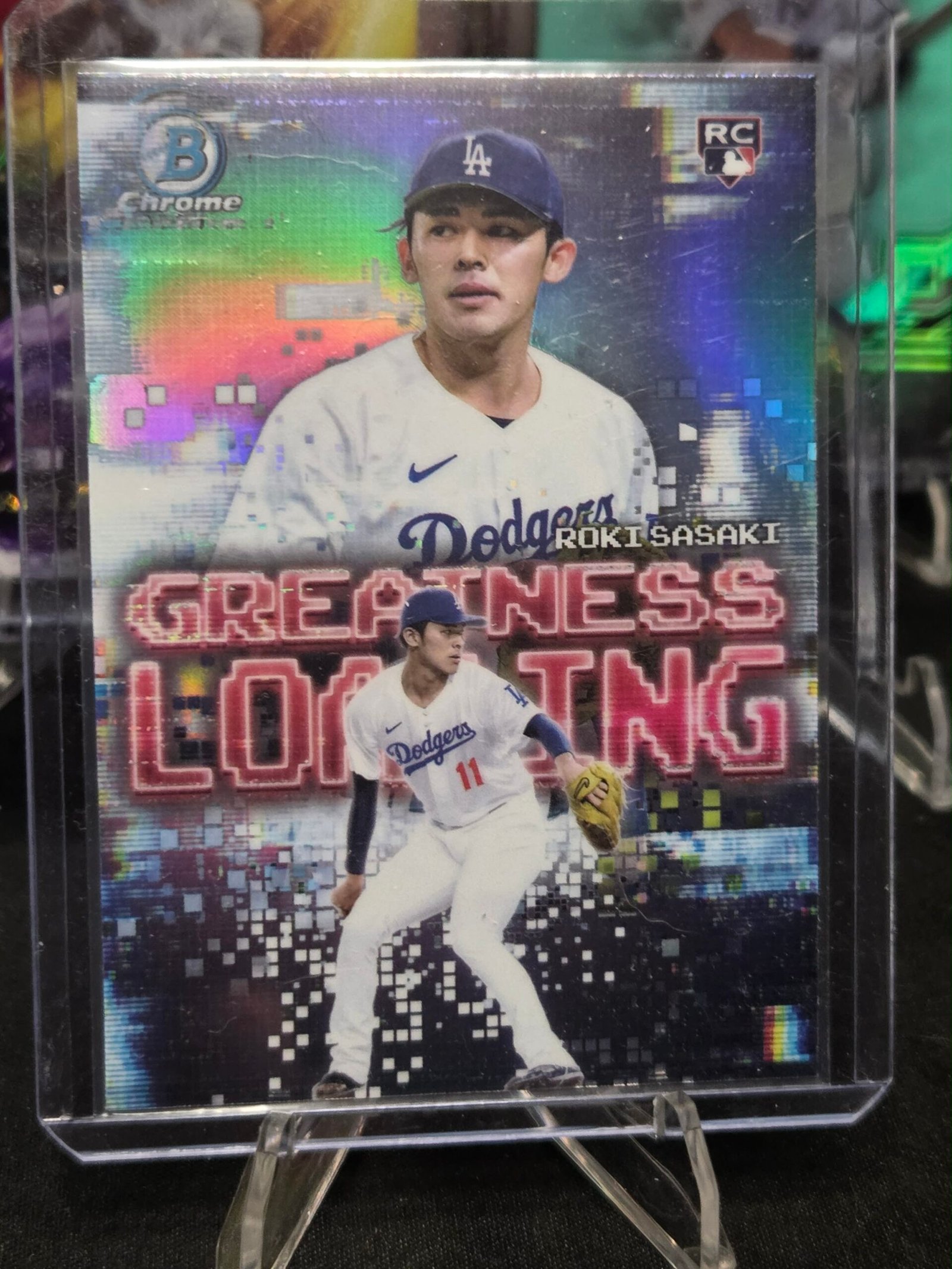
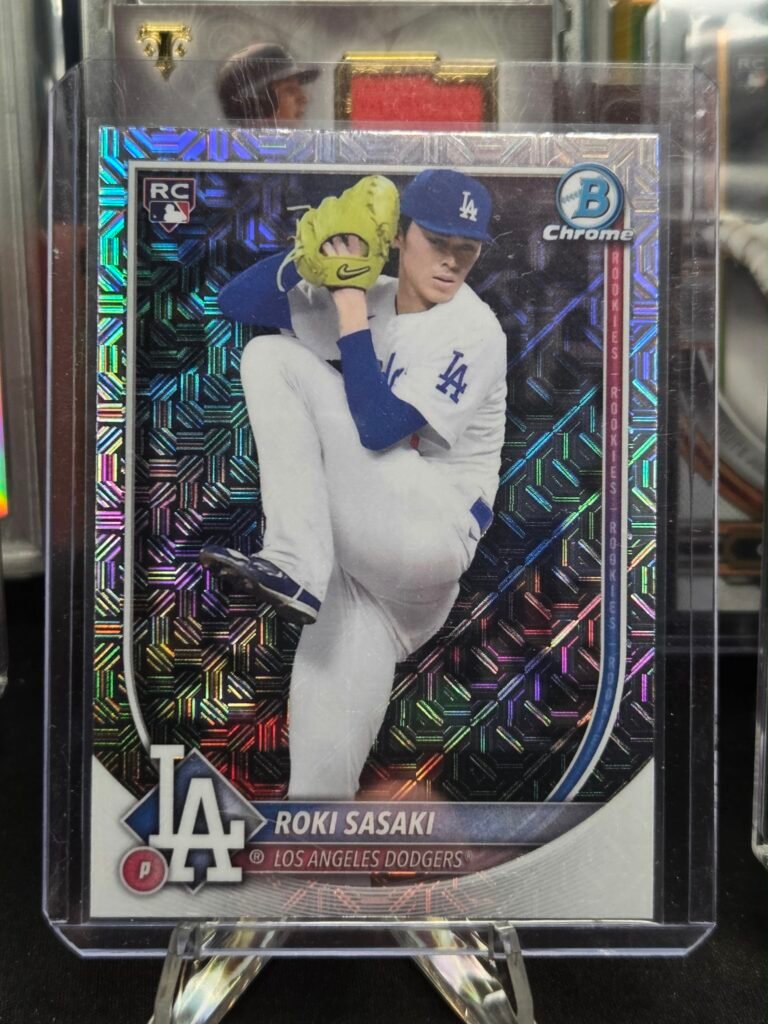
When Rōki Sasaki signed with the Los Angeles Dodgers and took the mound in the majors, collectors didn’t just get excited about a potential future ace — they also lit a fire under a growing market for his rookie cards. In this post I’ll run through who Sasaki is, what his rookie cards are currently going for, why his on-field performance is the single biggest lever for card value, and practical buying tips for collectors who want exposure without overpaying.
Who is Rōki Sasaki?
Sasaki arrived in MLB with a hefty reputation. The 23-year-old right-hander starred in NPB with eye-popping strikeout totals and a perfect game in April 2022 (19 K’s, including a record 13 consecutive strikeouts), then signed with the Dodgers in early 2025. He’s the type of high-ceiling pitcher — triple-digit fastball, plus swing-and-miss secondary pitches — who instantly becomes a prospect-market magnet.
Stat lines in the minors/early MLB outings have been a mixed bag (flashy stuff and high strikeout upside, but also the normal rookie bumps). For up-to-date season stats and game logs, MLB and ESPN are the quickest references.
The rookie-card landscape for Sasaki — what collectors are actually paying
Because Sasaki came to MLB already established in Japan, multiple “rookie” issues exist (Japan releases and the 2025 U.S.-market Topps/Topps Chrome sets). That multiplicity matters: not all “RC” cards are equal.
A few snapshot datapoints (late 2025 market behavior — note markets move fast):
- Topps Chrome (common ungraded/completed sales): Recent eBay reports and card-sale trackers show a lot of Topps Chrome Sasaki rookie listings selling in the low single-digit dollar range for ungraded copies, reflecting high print runs and plentiful supply for base parallels. SportscardsPro’s completed-sale reporting shows many Topps Chrome RC sales between roughly $0.65–$2.50 on eBay in recent reports.
- Topps Series / flagship graded examples: Price guides and snapshots for base Topps Series cards show a wider spread by grade. For one 2025 Topps Series 2 Sasaki RC, SportscardsPro’s guide lists values such as PSA 10 ≈ $90 and BGS 10 ≈ $117, while lower grades drop off steeply. (Special low-run parallel types like BGS Black or numbered parallels command much higher prices.)
- Beckett / price-guide references: Beckett maintains an active Sasaki price page for collectors who want a paid, rolling guide. These guides are useful for long-term reference but often lag short-term eBay/auction swings.
Bottom line: commons/ungraded Sasaki RCs are inexpensive at the moment; graded high-end examples and scarce parallels/autograph/patch cards are where meaningful money sits.
Why performance moves the needle (and by how much)
There are three core, measurable ways on-field performance impacts card value:
- Demand spike from breakout performance. A sudden stretch of elite results (All-Star selection, ROY talk, Cy Young-level peripherals) dramatically increases collector interest. That lift is magnified for pitchers because dominant young arms are rare and headline-grabbing (see the market reaction for Paul Skenes — elite rookie performance helped push a unique Skenes card into seven-figure territory). While Skenes is a one-off auction example, it demonstrates how performance + rarity = massive prices.
- Sustained career trajectory vs. short flash. Collectors and investors differentiate between a short hot streak and proven, multi-year dominance. Rookie cards of players who sustain elite performance for several seasons (All-Star selections, award finalists, consistent WAR contributions) appreciate far more reliably than those tied to a single breakout month.
- Scarcity and card-specific attributes amplify performance effects. A PSA 10 or an on-card autographed patch is structurally scarce. If Sasaki becomes a perennial ace, those graded/prized copies can inflate significantly — especially for low-population serial-numbered parallels or 1/1 items. Conversely, base ungraded commons (large print runs) will see far smaller percentage increases even if Sasaki becomes elite. SportscardsPro price histories show precisely this bifurcation in Sasaki’s market now.
Two realistic scenarios for Sasaki’s card values
Scenario A — Sasaki becomes an elite, multi-year ace
- Expect graded PSA/BGS 9–10 examples of premium releases and numbered parallels to climb substantially (several-fold increases over current guide prices), as happened historically with pitchers who became top-tier stars. Demand for early-run autographs and scarce parallels would be the major driver. Base commons will rise too, but much more modestly.
Scenario B — Sasaki shows flashes but is inconsistent / injury-impacted
- The market bifurcates: low-end commons remain inexpensive or fall; graded high-end examples hold value relative to supply but may stagnate or dip if upside looks limited. Autograph/patch cards lose speculative premium.
These scenarios map to how collectors historically reacted to foreign-market stars joining MLB: the excitement increases baseline demand quickly, and then long-term appreciation depends squarely on sustained MLB performance.
What to buy (collector strategy)
If you like Sasaki and want exposure without gambling your wallet:
- Speculative, low-cost exposure: buy ungraded Topps Chrome or flagship commons — cheap entry, easy to flip if demand spikes. Many of these are selling for single-digit dollars on eBay presently.
- Long-term collector play (moderate risk): buy mid-tier graded examples (e.g., PSA 8–10) of flagship/Topps cards or limited parallels if you can find a reasonable buy price. These have the best chance to appreciate materially if Sasaki becomes elite. Use price guides (SportscardsPro / Beckett) and population reports to set target buy prices.
- High-risk, high-reward: hunt for rarities — on-card autographs, patch cards, 1/1s. Only for deep-pocket collectors who accept major volatility; these are the items that can go parabolic if he becomes a generational talent (or crash if not).
Practical tips when buying
- Check recent completed sales, not listing prices. Completed eBay sales and SportscardsPro time-warp reporting show where real money changed hands. Listing prices can be wildly optimistic.
- Watch grading-population reports. Low-population PSA/BGS cards carry more upside. Grade-population info is critical in evaluating price vs. scarcity.
- Understand which card is considered the “true” rookie. For players with a long foreign career, there are multiple “rookie” stickers — U.S. Topps RC designation versus Japanese rookie issues. Each has a separate market.
- Don’t over-allocate to a single player. Even very promising pitchers face injury risk; diversify across players or formats (e.g., combine Sasaki commons with a graded autograph or a low-cost prospect).
Final take — excitement vs. reality
Rōki Sasaki’s arrival in MLB created immediate collector attention. Right now, the market shows low-cost liquidity for commons and a still-moderate premium for graded/top-parallel examples. If Sasaki fulfills top-of-rotation expectations and accumulates awards or All-Star seasons, the graded and scarce cards could see meaningful appreciation. If he flickers or battles injuries — the commons will stay inexpensive and the highest-end rarities may stagnate or fall. In short: performance is the switch — when Sasaki performs consistently at an elite level, his rookie cards move from “affordable curiosity” to “serious collectible.”
