

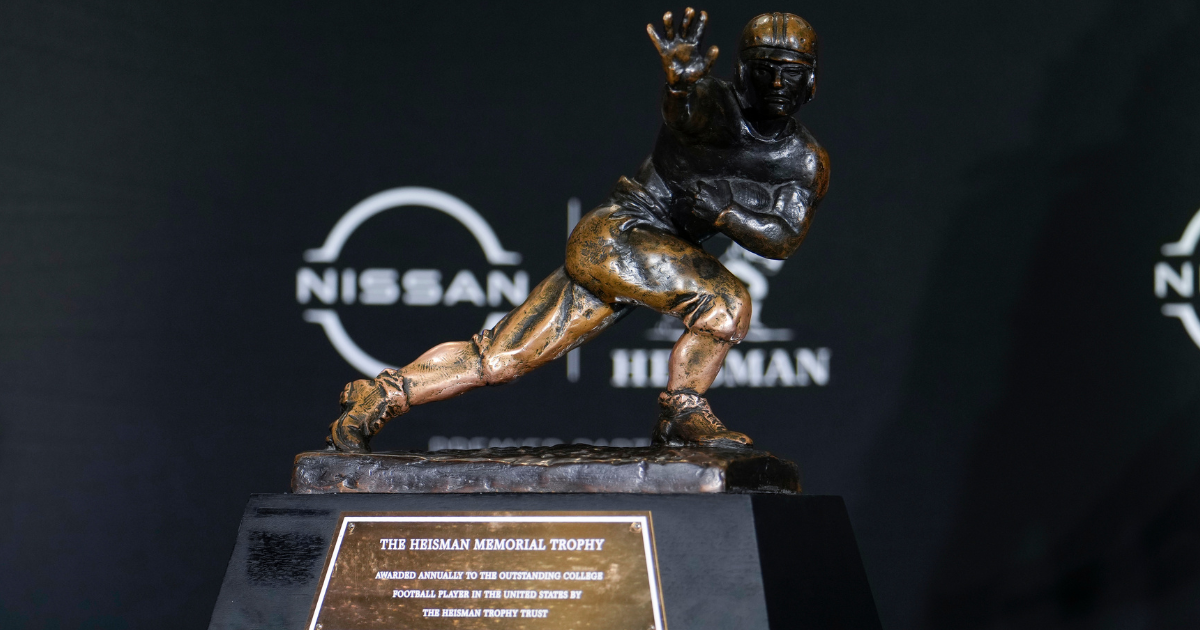
With the 2025 college football regular season wrapped up and conference championships concluded, a handful of players have emerged as the leading contenders for the Heisman. Some front-runners stand out because of gaudy stats; others because they’ve led their teams to major success.
Here are the top names:
Fernando Mendoza (Indiana QB)
- Mendoza is widely viewed as the favorite this year.
- He led his team to a perfect regular season, a Big Ten title and the No. 1 seed in the College Football Playoff — the first time in program history.
- Statistically: in 2025, he threw for nearly 3,000 yards and 33 touchdowns, with solid completion rate, and added value with his legs (rushing yards and rushing touchdowns).
Julian Sayin (Ohio State QB)
- In his first full season as a starter at Ohio State, Sayin has posted elite efficiency numbers — leading the nation in completion percentage.
- His statistical profile: over 3,300 passing yards, 31 touchdowns — and he’s shown consistency throughout the season.
Diego Pavia (Vanderbilt QB)
- Pavia has energized Vandy’s offense: by season’s end, he had thrown for over 3,100 yards and 27 passing touchdowns.
- Adding dual-threat value: he’s also been dangerous on the ground, with a high number of rushing yards and multiple rushing TDs — a trait that tends to appeal to voters looking for dynamic playmakers.
Jeremiyah Love (Notre Dame RB)
- Love has delivered a dominant season from the backfield: racking up 1,372 rushing yards and 18 rushing touchdowns — plus solid receiving numbers.
- He ranks among the national leaders in total touchdowns, all-purpose yards, scoring — and has shown big-play ability, including standout games vs marquee opponents.
These players combine elite personal production with team success — a potent mix for the Heisman voters.
What Makes This Heisman Class Stand Out (— or Feel “Weaker” Than Usual)
- The frontrunners are mostly quarterbacks and one running back — which continues the long pattern of offensive players dominating the Heisman race.
- Some of the usual heavyweights (big name programs, dual-threat QBs, wideouts, high-flying offenses) have underwhelmed, shaking up early season expectations.
- Because of that, every big performance — a late-season conference title, a clutch playoff winding up — has more weight, which benefits players like Mendoza and Pavia who peaked at just the right time.
All that said, this also makes a case for looking beyond traditional Heisman molds — which leads me to the next point.
Why Many Believe a Snub Could Have Happened — The Case of Jacob Rodriguez
Who is Jacob Rodriguez, and what did he do this season
- Jacob Rodriguez is a senior linebacker for Texas Tech. This season, he has totaled well over 100 tackles, double-digit tackles for loss, multiple interceptions, and — notably — forced a nation-leading number of fumbles.
- His highlight plays: in a marquee win vs. then-undefeated BYU, he racked up 14 tackles, made an interception and recovered a fumble — a performance so dominant he ended it with the classic “Heisman pose.”
- He also scored a 2-yard rushing touchdown in a game this season (yes — on offense), underlining his versatility and his coach’s awareness of what looks good for Heisman voters.
- Beyond Heisman-specific conversation, he has collected several of the biggest defensive awards: he’s a finalist for the Walter Camp Player of the Year (the only defensive player among the five finalists) , and he won the Bronko Nagurski Award this season, recognizing him as the nation’s top defensive player.
Given those credentials — game-changing big plays, dominance on defense, statistical excellence, impact on a top-ranked defense — many argued he deserved a seat at the Heisman table. “If the Heisman is truly awarded to the most outstanding player … Jacob Rodriguez deserves serious consideration.”
So why was he likely snubbed?
- Defensive bias (and tradition). Historically, the Heisman has overwhelmingly favored offensive players, especially QBs and RBs. Very rarely does a defender seriously contend; defenders must usually do something extraordinary to even get serious Heisman buzz.
- Positional value & the “highlight-drive bias.” Offensive players — quarterbacks and running backs — naturally generate the kinds of big, stat-heavy, highlight-reel plays that voters and media focus on. Defensive contributions are harder to fully quantify for casual voters, and may seem less flashy even when their impact is massive.
- Narrative & momentum. Many of the semifinalists and finalists (especially QBs like Mendoza and Sayin) had storylines involving perfect seasons, conference championships, and playoff qualification — narratives that tend to sway hype and voter sentiment even more than stats alone. That gives them a structural edge over defenders, even elite ones.
Indeed, some media outlets describing Rodriguez’s snub used terms like “after Heisman snub” when reporting his Nagurski win.
Why This Feels Like a Miss — But Maybe More than “Just” a Snub
I think the 2025 Heisman conversation exposed something deeper: that the Heisman — as currently judged — often fails to fully account for defensive dominance or game-changing two-way impact.
Jacob Rodriguez’s season wasn’t just “good for a defender.” It was among the single most impactful seasons in college football this year — regardless of side of the ball. His ability to force turnovers, change momentum, and even contribute on offense shows a rare versatility.
In a year where no single quarterback or running back absolutely dominated across all metrics, maybe it was the perfect moment to broaden the definition of “most outstanding player.” Not just the flashiest offensive stat-machine — but the guy who when he’s on the field, entire games tilt in his favor.
It may not result in a Heisman win for a defender this time around — but it should absolutely serve as a wake-up call for voters and media to expand their lens of what “outstanding” means.
What’s Next — Where Does This Leave the Heisman Conversation & Defense’s Role in It
- Even if Rodriguez doesn’t get the Heisman, his haul of other national defensive awards (Nagurski, Walter Camp finalist, possibly others) proves that defenders can get recognized — though often outside the Heisman framework.
- His snub could fuel renewed debate about whether the Heisman needs evolution: whether voters should be encouraged to give more weight to defense, versatility, and game-impact beyond offense.
- If enough elite defenders — like Rodriguez — have seasons this dominant, perhaps future Heisman races will have to seriously consider non-offensive candidates.
